
Why CPAP Devices Must Distinguish Central vs Obstructive Apneas
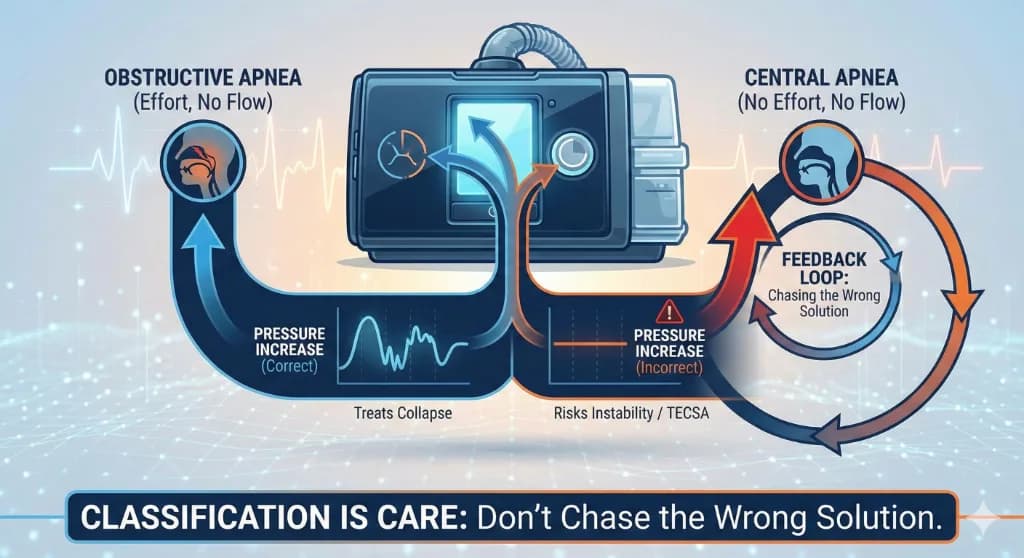
As someone who spends most of their waking life thinking about airflow curves, respiratory effort, and what CPAP data really means, I’ll say this plainly:
If a CPAP device cannot reliably distinguish central apneas from obstructive apneas, it can make the right patient look like the wrong problem.
That distinction is not academic. It directly affects pressure decisions, explains treatment-emergent phenomena, and prevents clinicians—and patients—from chasing the wrong solution.
Two apneas that look similar… but are not
On a basic airflow signal, both events may appear as “no flow.” Physiologically, however, they are fundamentally different.
Obstructive apnea: effort without flow
Respiratory drive is present The upper airway collapses or obstructs Inspiratory effort continues (often increases), but airflow ceases
Central apnea: no effort, no flow
The airway is typically patent The central respiratory drive temporarily diminishes or stops No inspiratory effort is present throughout the event
This distinction is formalized in sleep medicine standards. According to the American Academy of Sleep Medicine (AASM), obstructive apneas require ongoing respiratory effort, whereas central apneas are defined by its absence.
Why CPAP pressure can help one type—and worsen the other
This is where misclassification becomes clinically dangerous:
Obstructive apneas often respond well to increased airway pressure, which pneumatically splints the airway open.
Central apneas are not caused by airway collapse, so increasing pressure frequently offers no benefit—and in some patients may destabilize ventilatory control.
If a CPAP device misclassifies central apneas as obstructive and responds with pressure increases, the result can be:
- unnecessary pressure escalation,
- higher leak rates,
- more arousals,
- reduced comfort and adherence,
- and, paradoxically, more central events in susceptible patients.
In short, the device may enter a feedback loop where it “treats” the wrong mechanism.
The real-world problem: treatment-emergent central sleep apnea
A well-described phenomenon is treatment-emergent central sleep apnea (TECSA)—central apneas that appear or persist after initiating CPAP therapy for obstructive sleep apnea.
Large PAP telemetry studies show that TECSA:
- occurs in a meaningful subset of patients,
- follows distinct time-course trajectories,
- may resolve spontaneously or persist depending on patient-specific factors.
Systematic reviews further describe prevalence, risk factors, and clinical implications. These findings underline a key point: management strategies differ, and they depend on correctly identifying the apnea subtype.
How CPAP devices attempt to differentiate events
Unlike polysomnography, CPAP devices do not measure respiratory effort directly. Instead, they infer airway patency using airflow and pressure signals.
Forced Oscillation Technique (FOT)
Some devices superimpose small pressure oscillations during apnea and analyze impedance responses. A closed airway behaves differently from an open one.
Pressure pulse methods
Other devices apply brief pressure pulses and analyze resulting flow changes to estimate whether the airway is obstructed or open.
Important limitations of device-based classification
While these methods are sophisticated, they are inferential, not definitive.
Factors that can degrade classification accuracy include:
- large or variable leaks,
- mouth breathing,
- mask type and fit,
- cardiogenic oscillations,
- arousals and transitional breathing,
- borderline or short-duration events (especially hypopneas).
This is why device-reported apnea subtype should always be interpreted in context, not in isolation.
Why distinguishing apnea type matters clinically
1. It prevents pressure chasing
Raising pressure in a patient with predominantly central events often increases discomfort without improving outcomes.
2. It reveals mechanism, not just severity
Two patients may have the same residual AHI—but for entirely different physiological reasons.
3. It guides appropriate follow-up
A rising central apnea index should prompt evaluation for:
- treatment-emergent CSA,
- ventilatory control instability,
- medication effects (e.g., opioids),
- comorbid cardiopulmonary disease,
- signal artifacts or leak-related misclassification.
4. It aligns with professional scoring standards
Guidelines emphasize separating obstructive and central events for accurate interpretation and decision-making.
A practical takeaway
Residual AHI is not a single number—it is a composition.
Elevated OAI suggests persistent obstruction or inadequate airway support.
Elevated CAI suggests instability of respiratory control or treatment-emergent phenomena.
High leak undermines both detection and therapy effectiveness.
Before adjusting pressure, the essential question should always be:
“What type of events are we actually seeing?”
Final thought
CPAP devices are no longer just blowers—they are diagnostic instruments operating at scale. Their ability to distinguish central from obstructive apneas determines whether therapy is optimized intelligently or adjusted blindly.
In modern sleep medicine, classification is care.
Need help with a similar project?
Talk directly with an engineer about your requirements. We typically respond within 1 business day.
Related insights
A deep dive into LOOP, a portable and reusable NPWT platform focused on mobility, safety, adaptive therapy, and remote care readiness.
Connected medical devices improve care, but they also expand risk. Here are the core regulations and practical cybersecurity steps manufacturers should follow.
Low-power embedded systems are reshaping industrial reliability, edge intelligence, and long-life sensing in the field.