
Precision Measurement in Cement Lines: Reducing Downtime with Smart Tools
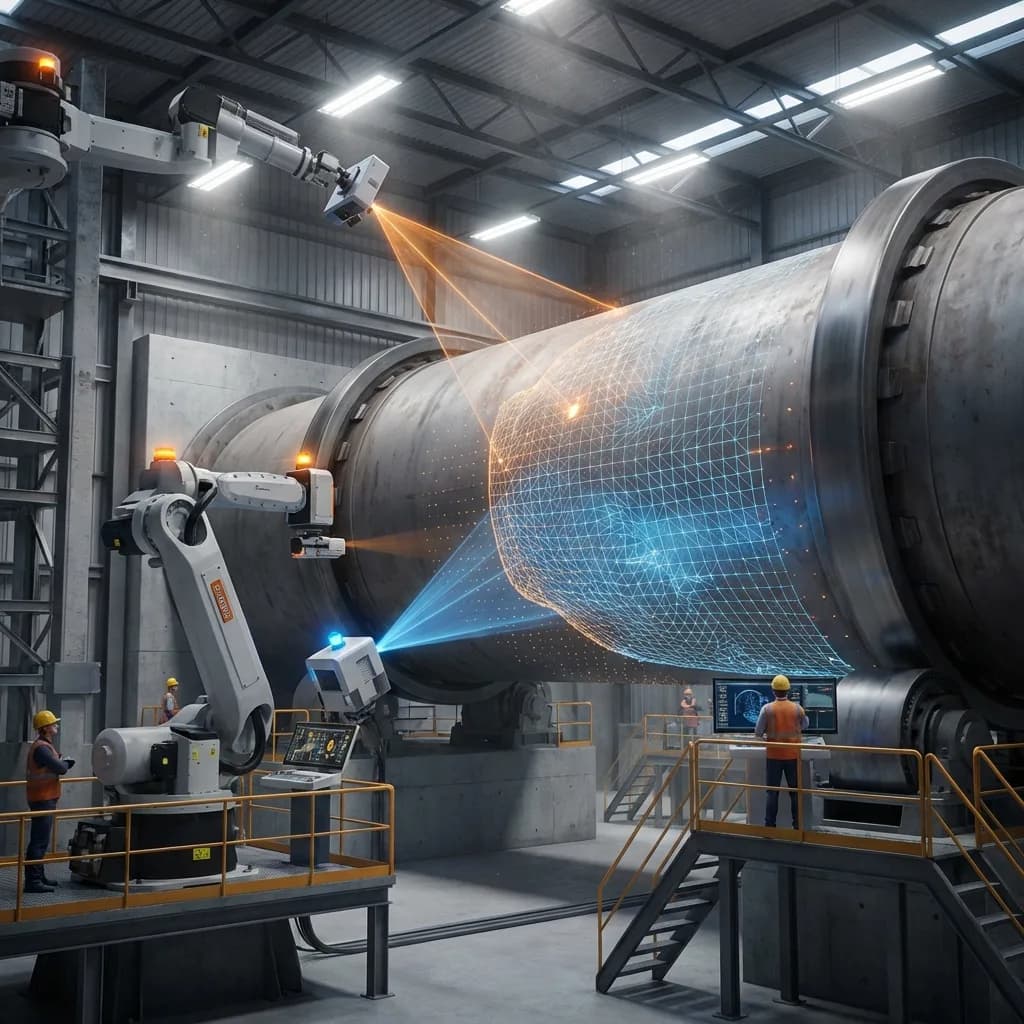
In a cement plant, “downtime” rarely comes from one dramatic failure. It’s usually the accumulation of small, measurable deviations—alignment drift, shell deformation, tyre migration, roller loading changes, clearance growth—that quietly push equipment from “stable” to “surprise stoppage.”
The good news: most of these problems announce themselves in geometry long before they become mechanical damage. The plants that win on availability treat precision measurement as a core reliability workflow, not an occasional shutdown activity.
Where downtime is born: the geometry chain
A typical cement line has multiple rotating assets where geometry directly affects reliability:
- Rotary kiln & tyres: ovality, crank/bending, tyre migration, shell temperature gradients
- Support rollers & bearings: load distribution, skew, thrust, lubrication stress
- Coolers, drums, conveyors: runout, misalignment, drive-train stresses
Many reliability guides explicitly call out shell scanners, ovality/deformation reporting, and alignment tools as practical levers to reduce unplanned downtime.
One especially useful example: industry literature notes that kiln shell ovality can be indirectly monitored via tyre migration, and that this can inform corrective actions before things escalate.
Precision measurement that pays back fast
1. Alignment surveys that catch “silent killers”
Misalignment doesn’t just waste energy—it creates cyclic loads that fatigue shells, tyres, shafts, and bearings. Research and field practice distinguish “hot” vs “cold” alignment approaches, and emphasize direct geometric measurement as the foundation for corrective action.
Practical takeaway: Don’t wait for the next major shutdown to “see how it looks.” Treat alignment like a periodic health check—especially after refractory work, roller service, or base/ground changes.
2. Ovality & deformation monitoring to protect refractory (and steel)
Ovality is not just a number—it’s a predictor of refractory stress and mechanical instability. VDZ discusses ovality measurement as a maintenance inspection topic and highlights its relevance to mechanical stability.
Meanwhile, kiln shell monitoring products are explicitly marketed around reducing costly unplanned downtime and increasing availability, because they detect abnormal conditions early.
Practical takeaway: A small deformation trend can be far cheaper to address than the cascade of refractory failure → overheating → shell damage → long outage.
3. Laser scanning & “as-is” reality capture to reduce rework
For large assets, contactless measurement can provide faster and more complete geometry capture—useful when you need a reliable “as-is” reference for analysis, maintenance planning, and verification. (This is widely used in industrial contexts, and the construction/industrial scanning literature emphasizes that accurate geometry supports better downstream decisions.)
Practical takeaway: When you need to validate structures, clearances, or component fit, accurate digital capture can prevent expensive “measure twice, cut once” mistakes.
The workflow that reduces downtime (not just “collects data”)
A measurement program becomes valuable when it’s tied to actions:
- Baseline the asset (alignment + key diameters/clearances + deformation indicators)
- Measure on a rhythm (after major work + periodic checks)
- Trend and threshold (look for drift, not just absolute numbers)
- Close the loop (adjust rollers, plan repairs, verify post-work geometry)
- Build a repeatable kit that operators can use consistently
This is what turns “precision measurement” into a downtime-reduction engine.
Where smart tools matter: fast, repeatable, field-ready measurement
In real cement environments—dust, heat, tight windows, production pressure—tools must be:
- quick to deploy
- robust and repeatable
- modular enough to match different measurement tasks
- designed for field workflows (not just lab specs)
That’s exactly the positioning of Alpha Teknoloji Ltd. Şti.’s MMD (Modular & Customizable) devices, presented as a platform where new techniques/sensors can be integrated based on measurement needs.
From the product listing, the MMD ecosystem includes components like a Measuring Wheel, Distometer, multiple inductive sensor ranges (0–40mm / 0–20mm / 0–10mm / 2–5mm), a Trigger Sensor, and the MMD Box, along with magnets and power accessories—suggesting a modular field kit approach rather than a single-purpose instrument.
The same page also frames the instrument as a high-accuracy diameter measurement device intended to help detect failures in advance and optimize maintenance, explicitly linking that to less downtime, longer equipment life, and lower maintenance costs across industries including cement.
How that helps in a cement line context
- Faster checks during tight stoppages (diameter/condition snapshots)
- Repeatable field measurements for trending (spot issues before they become outages)
- Adaptable configurations across different rotating equipment and measurement points
If you want this blog post to be even more product-specific, a strong next step is adding one concrete use-case section like: “Kiln tyre diameter trending before/after resurfacing” or “Roller station verification workflow”—and pairing it with a sample measurement checklist.
What to measure first: a practical “starter list”
If you’re launching or tightening a measurement program, prioritize assets where geometry most directly drives downtime:
- Rotary kiln: alignment, tyre migration indicators, ovality/deformation indicators
- Monitoring systems / scanners for early-warning on abnormal conditions
- Post-maintenance verification measurements (after roller/bearing/refractory work)
Closing thought
In cement lines, reliability often comes down to this: you either pay for measurement, or you pay for downtime—and downtime is almost always the expensive option.
Smart measurement tools plus a disciplined workflow turn geometry into an early-warning system. That’s how plants reduce surprise stoppages, plan maintenance confidently, and keep production predictable.
References
- Alpha Teknoloji – Rotary Kiln Measurement Equipments (MMD devices)
- The Cement Institute – Cement Kiln Maintenance (alignment tools, ovality reports, baselines)
- VDZ – Kiln maintenance (includes discussion of ovality measurement case study) [PDF]
- BK Vibro / World Cement April 2022 – tyre migration & ovality relationship [PDF]
- Fuller / FLSmidth – ECS/CemScanner kiln shell monitoring system (downtime/availability framing)
- Metso – Rotary Kiln Maintenance eBook (laser measurement equipment mention) [PDF]
- Research overview (hot vs cold alignment; total station / laser scanning mentions) – ResearchGate
Need help selecting the right product?
Talk directly with an engineer about your requirements. We typically respond within 1 business day.
Related insights
Our article on routine kiln measurements between hot kiln alignment surveys was published in the September 2026 issue of Global Cement Magazine. It explains how plant teams can track tyre migration, tyre axial run-out and roller shaft deflection with the MMD Kiln Inspection Tool. Read it online or download the PDF.
A Practical Guide for Cement Kilns: How to select the right combination of sensors specifically for cement kiln monitoring, based on real operational needs.
Our MMD rotary kiln and dryer measurement systems are now available in the United States through J.F. Menzia & Sons LLC, rotary equipment specialists with roots in the industry going back to the 1950s.